
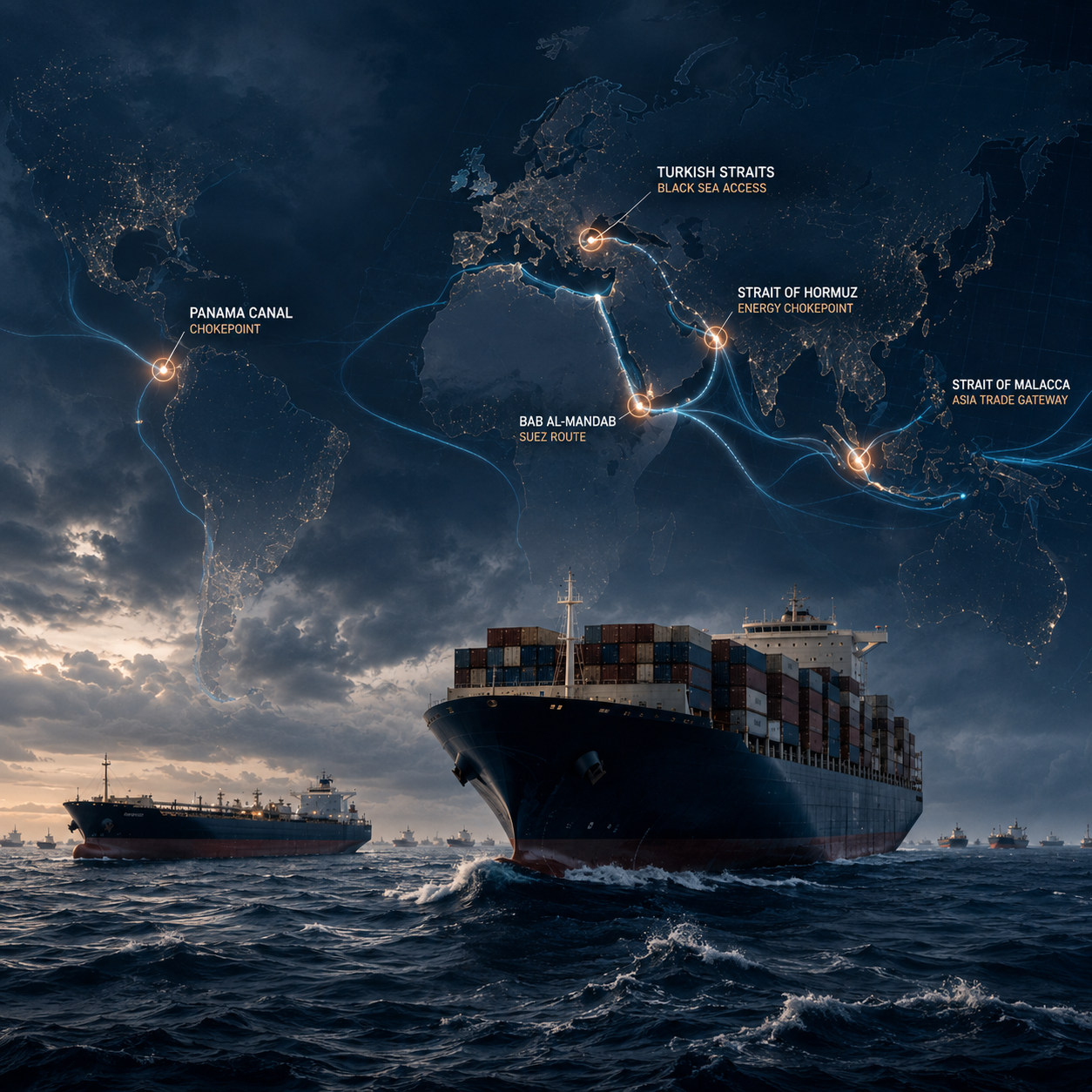
TLDR: Maritime chokepoints do not need to be fully closed to disrupt the global economy. Rising insurance premiums, longer routes and higher fuel consumption are enough to drive up prices for consumers worldwide. Hormuz threatens energy supplies, while the Houthi campaign at Bab al-Mandab has redirected shipping around Africa and sharply reduced Egypt’s Suez revenues. Malacca and the Taiwan Strait expose Asian energy imports and global industry. Drought constrains the Panama Canal, while conflict in the Black Sea endangers grain exports. The greatest risk is simultaneous disruption: once insurers and shipping companies judge a route too dangerous or too expensive, local insecurity becomes global inflation.
When a maritime chokepoint becomes unsafe, goods do not usually disappear at once. Costs rise first. Shipping companies consume more bunker fuel, ships and crews remain tied up for longer, insurers impose war-risk premiums, and carriers add surcharges. These additional costs move through freight rates, energy prices and industrial inputs until they reach the consumer. Maritime chokepoints are therefore global price multipliers long before they become physical supply crises.[1]
Hormuz: The Crisis Is No Longer Hypothetical
The Strait of Hormuz is no longer merely a hypothetical risk. After a brief easing of tensions, Iran declared the strait closed to unauthorised tankers again on 12 July 2026. By mid-July, normal traffic had largely come to a halt. The strait has not been sealed completely: Tehran continues to allow approved vessels to pass. For unrestricted commercial shipping, however, the present combination of inspections, authorisation requirements and military threats amounts to an effective closure.[2]
Before the crisis, around 20.9 million barrels of crude oil and petroleum products passed through Hormuz each day during the first half of 2025. This represented roughly one quarter of all oil transported by sea worldwide. The strait also carried about one fifth of globally traded liquefied natural gas, almost all of it originating in Qatar. By the first quarter of 2026, oil flows had already fallen to an average of 14.6 million barrels per day. China, India, Japan and South Korea are particularly dependent on the route. These figures come from the US Energy Information Administration, the statistical and analytical agency of the US Department of Energy.[3]
Iran can raise the cost of transit through mines, drones, coastal missiles, fast attack craft and ship inspections. It does not need to stop every vessel physically. Once insurers withdraw coverage and shipping companies hold their tankers back, the threat has achieved its purpose. Higher oil and gas prices then feed into electricity, transport fuels, fertilisers, plastics and industrial production.
Iran has no general legal authority to close the strait. Article 44 of the United Nations Convention on the Law of the Sea prohibits coastal states from obstructing or suspending transit passage through international straits. Iran has signed but not ratified the convention. Even so, the basic freedom of transit passage is widely regarded as customary international law.[4]
The legal position becomes more complex during armed conflict. Iran might seek to exclude enemy warships, or ships directly supporting an adversary, from its own territorial waters. That does not create a right to stop neutral merchant vessels indiscriminately, charge them for passage or close the strait as a whole. The current authorisation regime therefore lacks a generally recognised basis in international law.[5]
Bab al-Mandab and Suez: An Iranian Proxy Hits Egypt
The attacks on commercial shipping began on 19 November 2023 with the seizure of the Galaxy Leader. The Houthis, armed and supported by Iran, subsequently developed their campaign into a persistent threat to shipping in the Red Sea. They are therefore not merely a Yemeni party to a civil war, but a central Iranian proxy capable of extending Tehran’s strategic reach far beyond the Persian Gulf.[6]
Bab al-Mandab, the Red Sea and the Suez Canal form a single maritime corridor. Before the attacks, around 10 per cent of global seaborne trade and, according to the United Nations Conference on Trade and Development — the UN body responsible for trade and development issues — approximately 22 per cent of global containerised seaborne trade passed through Suez. Other estimates, depending on their methodology, place the canal’s share of global container traffic as high as 30 per cent. Allianz Commercial estimated that around 40 per cent of total trade between Asia and Europe used the canal. There is no single authoritative figure for container traffic between the two regions alone, but Suez remains the dominant regular maritime route connecting them.[7]
The Houthis do not need to close the corridor. It is enough to attack selected vessels and thereby increase the perceived risk for all shipping. Many carriers now divert around the Cape of Good Hope. For voyages between East Asia and Northern Europe, this adds roughly 4,000 nautical miles and, on average, 10 to 12 days.[8]
Maersk estimated that the additional fuel cost on affected routes averaged around 40 per cent. Across its wider network, the diversions increased quarterly bunker-fuel consumption by approximately 14 to 18 per cent. At the same time, ships remain at sea for longer. The effective size of the available fleet therefore contracts even when no vessel is lost.[9]
The effects reach directly into the Egyptian state budget. Before the crisis, foreign-currency revenues from the Suez Canal amounted to around 2.2 per cent of Egypt’s gross domestic product. During the first eleven months of 2024, these revenues were 62.6 per cent lower than in the same period a year earlier. The International Monetary Fund estimated the total revenue loss for the year at around six billion dollars.[10]
Measured against the size of the economy, the lost canal revenues were equivalent to roughly 1.4 per cent of Egyptian GDP. This does not mean that GDP itself automatically fell by the same amount. It does, however, indicate the scale of the lost foreign-currency inflow. For a heavily indebted country that depends on food and energy imports, this weakens reserves, creditworthiness and fiscal room for manoeuvre. An Iranian proxy can therefore do more than threaten merchant ships: it can undermine Egypt’s macroeconomic stability.
Malacca and Taiwan: The Same Barrels, a Different Risk
More than 20 million barrels of oil also pass through the Strait of Malacca each day. During the first half of 2025, the figure was around 23.2 million barrels — even more than through Hormuz. These volumes must not simply be added together. Many tankers leave the Persian Gulf through Hormuz and later pass through Malacca on the same voyage to China, Japan or South Korea. The same barrel is therefore counted at two different chokepoints.[11]
Hormuz primarily reflects dependence on producers in the Persian Gulf. Malacca demonstrates the vulnerability of Asian consumers. A disruption in Hormuz blocks exports close to their source; a disruption in Malacca blocks access to industrial East Asia.
Beyond Malacca lie the South China Sea and the Taiwan Strait. The Washington-based Center for Strategic and International Studies estimated the value of goods transported through the Taiwan Strait in 2022 at approximately 2.45 trillion dollars — more than one fifth of global seaborne trade. The cargo includes not only energy, but also semiconductors, electronics, machinery and industrial inputs.[12]
The principal geopolitical threat is a Chinese quarantine or blockade of Taiwan. Even inspections, large-scale military exercises or temporary exclusion zones could persuade insurers and shipping companies to reroute traffic. China would also damage itself, since a substantial proportion of its energy imports and coastal trade uses the same waters. A Taiwan crisis would therefore be more than a supply-chain disruption. It would represent a simultaneous shock to industry, financial markets, trade and sanctions regimes.
Panama: Water Becomes Transport Capacity
The Panama Canal is particularly important for routes connecting the US Gulf and East Coasts with Asia. A single percentage for all US agricultural or energy exports would, however, be misleading because dependence on the canal varies considerably by commodity and destination.
The concentration is nevertheless substantial in agriculture. According to the US Department of Agriculture, around 41 per cent of maize exported through US Gulf ports in 2022 and 51 per cent of soybeans shipped from those ports were destined for East Asia. Panama is normally the preferred route for these cargoes.[13]
Among energy exports, liquefied petroleum gases are particularly exposed. According to the US Energy Information Administration, liquefied petroleum gas and ethane accounted for 63 per cent of US petroleum-product exports that passed through the canal. During the low-water period at the end of 2023, canal transits by US liquefied petroleum gas carriers fell by 23 per cent, while ethane shipments declined by 73 per cent.[14]
Each lock passage requires large quantities of freshwater from the canal’s reservoirs. The same water also supplies Panama’s population. During the drought of 2023 and 2024, the canal authority had to restrict vessel draughts and the number of daily transits. A transport bottleneck became a distributional conflict between global trade and domestic drinking-water needs.
The connection with climate change requires nuance. The exceptional drought of 2023 was driven substantially by El Niño and cannot be attributed to anthropogenic climate change alone. Over the longer term, however, rising temperatures, less predictable rainfall and more intense dry periods are increasing the risk. The canal authority is therefore expanding water-storage capacity and describes climate adaptation as essential to the canal’s future reliability.[15]
The Black Sea: Grain Becomes Geopolitical
The Bosporus and the Dardanelles connect the Black Sea to the Mediterranean. Around 3.7 million barrels of crude oil and petroleum products passed through the Turkish Straits each day in 2025. Strategically, however, grain, sunflower oil and fertilisers may be even more important. Before the war, Russia and Ukraine together accounted for almost one quarter of global exports of wheat, maize and barley, according to the Food and Agriculture Organization of the United Nations.[16]
Attacks on ports and storage facilities, naval mines and risks to merchant ships increase prices particularly for import-dependent states in North Africa, the Middle East and Asia. In those countries, rising grain prices place pressure on public budgets and subsidy systems and can intensify social tensions.
Turkey also controls the only maritime access to the Black Sea. Under the Montreux Convention, it can restrict the passage of warships. The Bosporus and Dardanelles are therefore at once a trade route, a diplomatic instrument and a military barrier.
Risk Becomes Cost First
Most maritime chokepoints can be bypassed. But every diversion requires more fuel, more ships, more crews and more time. When several chokepoints are under pressure simultaneously, those alternatives quickly become less viable.
Hormuz and Bab al-Mandab can be affected by the same regional conflict. Malacca and Taiwan form part of the same Asian supply axis. Suez and Panama can partially substitute for one another, yet both are themselves vulnerable — one to war, the other to climate and water scarcity.
The decisive question is not whether a strait can be closed completely. It is when insurers and shipping companies decide that using it has become too risky or too expensive. From that moment, local insecurity becomes global inflation.
Notes and Sources
[1] US Energy Information Administration. “Oil and Petroleum Products Explained: Oil Prices and Outlook.” Accessed July 23, 2026.
https://www.eia.gov/finance/markets/products/trade.php
[2] Reuters. “Iran Declares Strait of Hormuz Closed; Unauthorised Vessel Hit.” July 11, 2026.
https://www.reuters.com/world/asia-pacific/iran-declares-strait-hormuz-closed-unauthorised-vessel-hit-2026-07-11/
[3] US Energy Information Administration. “World Oil Transit Chokepoints.” Accessed July 23, 2026.
https://www.eia.gov/international/content/analysis/special_topics/World_Oil_Transit_Chokepoints/
[4] United Nations. United Nations Convention on the Law of the Sea. December 10, 1982.
https://www.un.org/depts/los/convention_agreements/texts/unclos/unclos_e.pdf
[5] Opinio Juris. “The Closure of the Strait of Hormuz by Iran: Considerations over the Law of the Sea and Law of Naval Warfare.” May 6, 2026.
https://opiniojuris.org/2026/05/06/the-closure-of-the-strait-of-hormuz-by-iran-considerations-over-the-law-of-the-sea-and-law-of-naval-warfare/
[6] International Maritime Organization. “FAL 48/20/Add.1.” Accessed July 23, 2026.
https://wwwcdn.imo.org/localresources/en/OurWork/Facilitation/Facilitation/FAL%2048-20-Add.1.pdf
[7] United Nations Conference on Trade and Development. Review of Maritime Transport 2024: Overview. Geneva: United Nations, 2024.
https://unctad.org/system/files/official-document/rmt2024overview_en.pdf
[8] Allianz Commercial. Safety and Shipping Review 2025. Munich: Allianz Commercial, 2025.
https://commercial.allianz.com/content/dam/onemarketing/commercial/commercial/reports/commercial-safety-shipping-review-2025.pdf
[9] A. P. Moller–Maersk. “Navigating Challenges in the Red Sea and Beyond.” June 12, 2024.
https://www.maersk.com/news/articles/2024/06/12/navigating-challenges-in-red-sea-and-beyond
[10] International Monetary Fund. Report on Egypt and the Economic Effects of Suez Canal Disruptions. Washington, DC: International Monetary Fund, 2025.
https://www.elibrary.imf.org/downloadpdf/display/book/9798400272356/CH001.pdf
[11] US Energy Information Administration. “World Oil Transit Chokepoints.” https://www.eia.gov/todayinenergy/detail.php?id=18991
[12] Center for Strategic and International Studies. “Disruptions to Trade in the Taiwan Strait Would Severely Impact China.” ChinaPower Project, 2024.
https://features.csis.org/chinapower/china-taiwan-strait-trade/
[13] US Department of Agriculture, Agricultural Marketing Service. Grain Transportation Report. November 23, 2023.
https://www.ams.usda.gov/sites/default/files/media/GTR11232023.pdf
[14] US Energy Information Administration. “Low Water Levels Reduce Panama Canal Transits of US Liquefied Petroleum Gas.” 2024.
https://www.eia.gov/todayinenergy/detail.php?id=61443
[15] World Weather Attribution. “Low Water Levels in Panama Canal Due to Increasing Demand, Exacerbated by El Niño Event.” 2024.
https://www.worldweatherattribution.org/low-water-levels-in-panama-canal-due-to-increasing-demand-exacerbated-by-el-nino-event/
[16] US Energy Information Administration. “Energy Security and Global Chokepoints.” Short-Term Energy Outlook. Accessed July 23, 2026.
https://www.eia.gov/outlooks/steo/report/energysecurity/article.php
Leave a Reply