
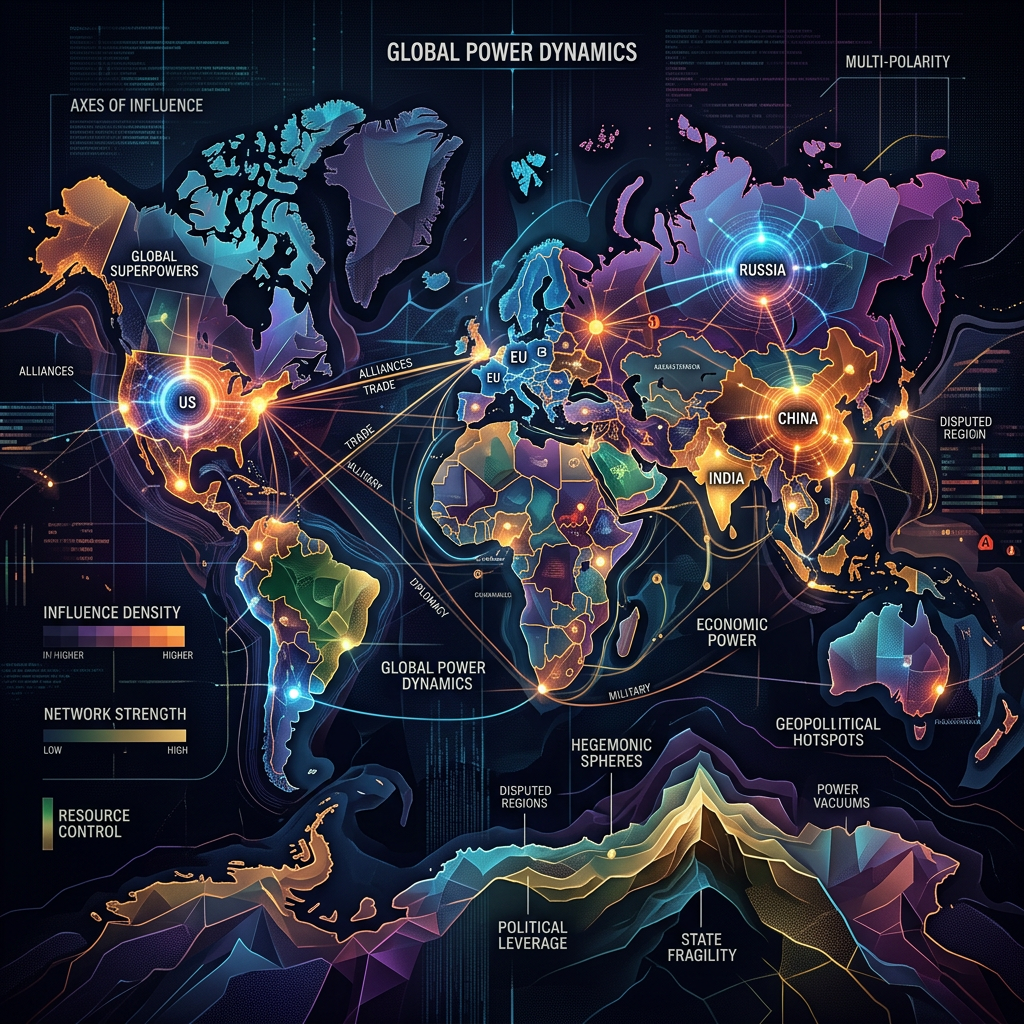
History is moving geographically, once more.
For a long time, power appeared simple. It lived in capitals, in castles, in parliaments and presidential residences. It lived in ministries with marble floors, in military headquarters behind iron gates and maybe still in stock markets or conventional markets. Maps were coloured in blocks. History was explained through nations, armies, ideologies, and treaties. Westphalian thinking trained us to think in these terms, until merely a few years ago. The world was divided into camps, defined by borders and flags, powered by industrial output and military capacity mattered.
Much of that world still exists. But it no longer explains everything. The world shows bizarre behaviour, and the grand theories of most social sciences are constantly falsified. The mighty US military struggles to keep the local hegemonial power Iran in check. The once feared Russian Army – self-proclaimed as the second strongest army in the world – struggles to advance against the resistance of their smaller neighbour Ukraine and has only captured one major city – Mariupol – in 4.5 years of slaughter. On a smaller scale, the heavily armed military regime in Myanmar is unable to break the resistance forces of the anti-junta movement.
To understand power now, one must leave the capital and travel to hubs and nodes. Power today moves through networks before it moves through governments. We see it in ports, in fibre landing stations along coastlines, in sovereign wealth offices in glass towers overlooking the Gulf, in railway corridors in Central Asia, in semiconductor manufacturing plants and in major media corporations or tech companies. We see it particularly when an element is failing. When a shipping chokepoint is blocked by a single container shit somehow stuck in a canal, or when missile threats drive insurance companies to factually stop movement through the strait of Hormuz. We see it one day, when an electrical transformer station in Laufenburg, Switzerland, is sabotaged or otherwise hit, and affects power supply in Germany and France.
The old world was organized vertically. To conquer, you occupied the palace, in more modern times maybe also the public radio broadcasting station and the airport. The new world is organized horizontally and in network nodes. Cables, trade routes, pipelines, supply chains, migration corridors, satellite constellations, payment systems, media ecosystems, and digital platforms now shape the balance of power as decisively as armies once did.
For three decades after the Cold War, many believed geography itself was fading. The internet promised a frictionless and borderless world. Finance floated above borders. Globalization appeared inevitable. Flying and thus traveling has become as affordable as never before in the history of humankind. Distance seemed irrelevant. A generation of elites began speaking the language of abstraction: platforms, innovation, disruption, global citizenship.
Then reality returned. Covid-19 closed borders. Energy shocks destabilized governments. Russian’s invasion of Ukraine disrupted grain exports and shipping lanes. Semiconductor shortages slowed entire industries. Undersea cables became strategic assets. Rare earth minerals suddenly mattered. Ports mattered. Industrial policy returned. Media corporations control information and opinions, and they do it mostly along media regulatory borders, which are national borders. Nations rediscovered the importance of manufacturing capacity, resource supply, maritime access, and strategic depth.
This is the defining condition of the twenty-first century: hyperconnectivity combined with fragmentation. The same technologies that linked the world also intensified competition within it. Globalization has not eliminated power politics and is currently unlikely to ever do so. Geography survived the digital age because the digital age still depends on a physical backbone and physical systems, and these physical systems are still organised along physical obstacles, separated by mountains and oceans. Clouds require warehouses full of servers, preferably within reasonable regulatory (and thus national) boundaries; artificial intelligence requires energy infrastructure and advanced chips, preferably under our own control to avoid or at least reduce the involuntary sharing of proprietary data. Streaming platforms rely on undersea cables laid across contested oceans. E-commerce depends on ports, trucking routes, warehouses, and stable maritime corridors. Behind every “virtual” system is hard physical architecture, which belongs to people and corporations, and is under the control of nations and political regulation.
The great illusion of modernity is that we escaped geography. In truth, we embedded ourselves deeper inside it. Look closely at the modern world and the old patterns emerge again. Naval power including naval posturing is returning. The Indian Ocean, once peripheral in Western strategic thought, is rapidly becoming central. The Arctic is opening and might suddenly offer alternatives to known trading routes. The Eastern Mediterranean has become an energy theatre. The Red Sea matters again. The Strait of Hormuz is headline material and the strategic focus of arguably the last superpower. Singapore, Dubai, Istanbul, Doha, and Rotterdam are not merely prosperous cities; they are strategic nodes of various circulating things, from cargo containers to currency to fibre optic signals to tax systems. These places are therefore crucial, as influence belongs not only to nations but to their control of gateways and chokepoints. A gateway concentrates movement: goods, money, people, information, prestige. Historically, cities that controlled circulation have always become powerful beyond their territorial size. Venice, Constantinople, Chang’an (now Xi’an), Carthage, Timbuktu, London. Powerful nodes shape the intersection of aviation, finance, shipping, media, logistics, and diplomacy, and chances are that the twenty-first century belongs to these nodes and connectors, rather than to nations alone.
This shift has altered the character of states themselves. Traditional nation-states have strived to project power primarily through territorial control. Today they compete through infrastructure, connectivity, and systems integration. China’s Belt and Road Initiative is not merely a construction program; it is a geopolitical theory expressed through ports, railways, industrial zones, and debt relationships. American influence is weakened everywhere because apart from financial architecture, cultural platforms and technological ecosystems, it still rests heavily on military alliances (which are currently abandoned), the petro-dollar (which might not survive without international friendships supporting it) and moral leadership in a democratic global world of human rights and the rule of law (which is currently actively deconstructed).
Because power depends on the ability to shape flows of things and thoughts, infrastructure has become political. In previous eras, political ideas were transmitted through speeches, manifestos, and revolutions. Today they are embedded in systems. Payment rails determine economic alignment. Telecommunications standards create dependencies. Operating systems shape information environments. Supply chains reorganize political relationships without requiring conquest. The empires of the future may look less like territorial occupations and more like infrastructural ecosystems. The successful superpower of the future may not be the largest, but it might likely be the most indispensable. And it will be indispensable because it controls not the raw resource, but the flow of it.
Meanwhile, another frontier is emerging beneath public attention: the geography of technology.
Artificial intelligence, for all its abstraction, is profoundly geographical. Advanced AI depends on semiconductor fabrication concentrated in a handful of regions. It depends on enormous energy consumption. It depends on stable political environments capable of supporting advanced research ecosystems. The struggle over chips is therefore not merely economic. It is strategic. The same is true of data centres, satellite infrastructure, and rare earth supply chains. Technology has not liberated humanity from physical constraints. It has reorganized those constraints into new strategic forms.
In this environment, the old distinction between civilian and military infrastructure begins to blur. Ports can serve naval and commercial purposes simultaneously. Satellites guide both agricultural systems and missile targeting. Telecommunications networks enable freedom of speech and authoritarian oppression. Commercial shipping data becomes strategically valuable. Logistics companies acquire geopolitical importance. All these technologies and infrastructures are dual-use by default and by design
This creates a strange new world in which bankers discuss maritime chokepoints, military planners study semiconductor supply chains, and technology executives speak the language of national security. Entire professions are converging around two very basic insights: geography has returned, hand in hand with strategy.
The future belongs to those willing to travel through systems and disciplines rather than merely observe one of them. Future analysts might move slower, not faster, more observant, not more superficial. Good analysts will treat ports with the same seriousness as parliaments, and shipping, energy, migration, technology, and diplomacy as interconnected. The illusion of a placeless world is ending. What emerges instead is a harder landscape defined by corridors, chokepoints, strategic cities, technological monopolies, and competing civilizational visions. A world simultaneously ancient and futuristic. Hypermodern in its technological complexity, but maybe somewhat medieval or feudal in its fragmentation.
And yet geography alone is insufficient. The modern world is shaped not only by mountains and oceans, but by human ambition layered upon them. Every cable route, financial centre, port expansion, or rail corridor reflects choices about the future. Infrastructure is destiny made concrete.
The coming decades will likely be defined not by one dominant empire, but by overlapping systems competing for influence. American networks, Chinese networks, Gulf networks, European institutions, digital platforms, private capital, sovereign wealth, AI ecosystems, and logistical architectures will coexist, compete, and entangle one another. The result will not be a stable order with a clear ideological conflict line, but a dynamic geography of power, always shifting and adapting.
History is moving geographically once more.

Leave a Reply